Top 10 Best Pressure Cookers in India 2026: Reviews & Buying Guide
13 February 2026

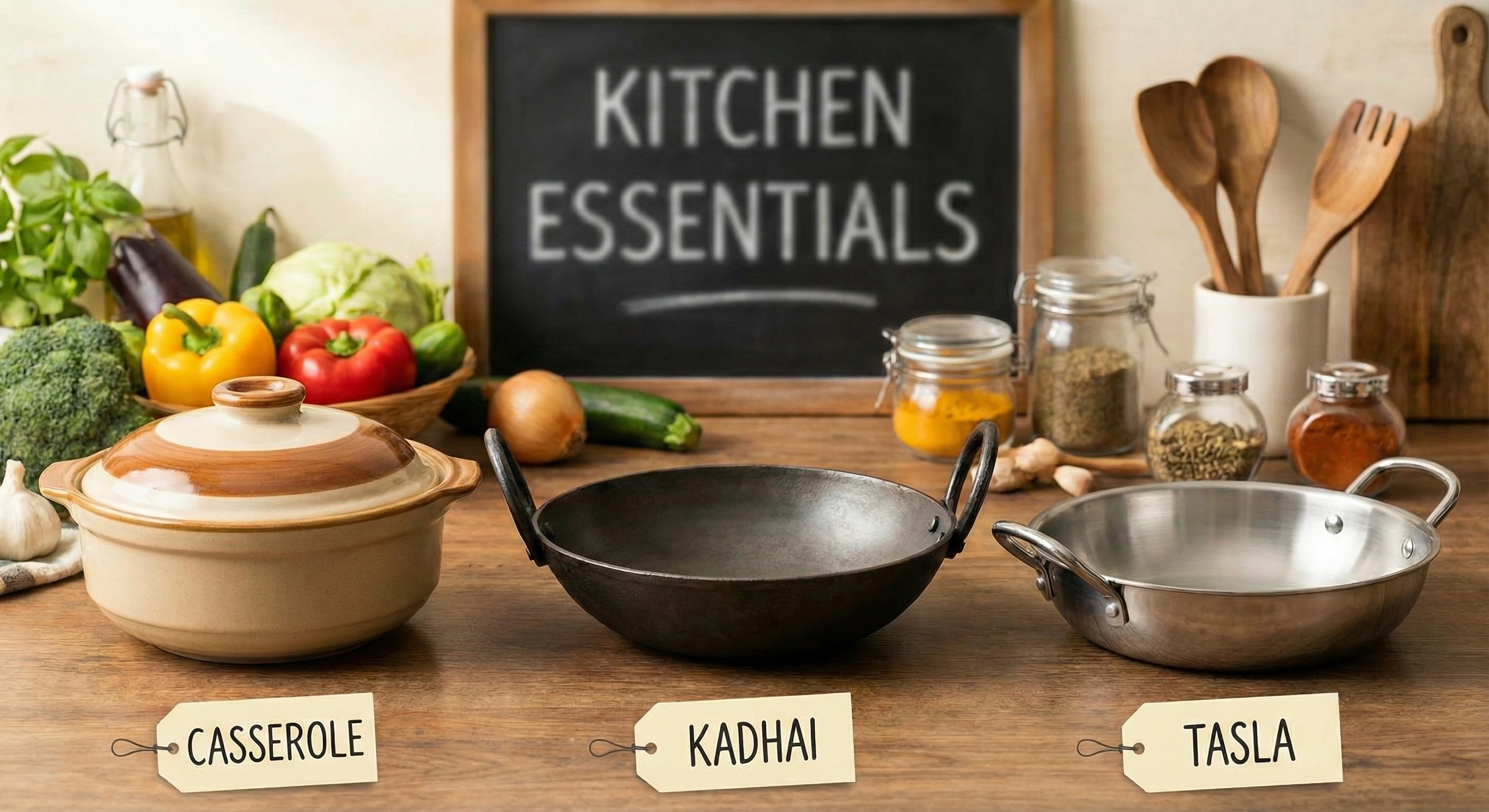
You’re staring at three different pots online. One says casserole. Another says kadhai. Third one? Tasla. They all look kinda similar. Round. Deep. Metal. What’s even the difference?
Here’s the thing – most Indian kitchens have all three. But if you’re just starting out or working with limited space, knowing which one does what can save you money and cabinet space.
Let’s break down what makes each one different and which situations call for which pot.
Before getting into specifics, here’s the quick version:
Yeah, they overlap in some uses. But the design differences matter more than you’d think.
Walk into any Indian home and you’ll find at least one casserole. Some fancy stainless steel one sitting in the corner cabinet. Why? Because it does a lot of jobs pretty well.
Casseroles have straight walls and a tight-fitting lid. The handles sit on opposite sides – makes carrying easier. Most come in 1L to 5L sizes. Material matters here. You’ll find them in:
High heat frying? Not ideal. The straight walls mean less surface area exposed compared to a kadhai. You can fry in it, but it’s not optimal. Quick stir-frying also doesn’t work great. You need curved walls to toss ingredients easily.
If someone said “pick only one cooking vessel,” most Indian cooks would grab a kadhai. For good reason.
Traditional kadhais have a rounded bottom and sit in a stand or directly on flame. Modern ones have flat bottoms for gas and induction compatibility. Two loop handles stick out from the sides. Material choices include:
Learn more about different kadhai materials and which performs best in our detailed kadhai buying guide.
Serving directly in a kadhai? Not really. The loop handles aren’t convenient for table serving. Oven use? Most kadhais aren’t oven-safe, especially cast iron ones with wooden handles.
Here’s where it gets interesting. Taslas don’t get enough credit. Most people see them as mixing bowls. They’re way more useful than that.
Taslas look like wide, shallow bowls. Flat or slightly rounded bottom. No handles in traditional designs – though modern ones might have small ones. Usually made from:
Deep frying? No. Too shallow, oil will splatter everywhere. Cooking with lots of liquid? The low walls mean you can’t fill it much without spilling risk.
| Feature | Casserole | Kadhai | Tasla |
|---|---|---|---|
| Depth | Deep (4-6 inches) | Medium-deep (3-5 inches) | Shallow (2-3 inches) |
| Lid | Yes, tight-fitting | Sometimes (sold separately) | Rarely |
| Handles | Two side handles | Two loop handles | None or small ones |
| Best For | Slow cooking, serving | Frying, curries | Mixing, kneading |
| Heat Distribution | Even throughout | Concentrated at bottom | Quick surface heating |
| Versatility | High (cook + serve) | Very high (multiple cooking styles) | Medium (prep + some cooking) |
| Storage | Stackable with lid | Needs space due to handles | Very stackable |
| Price Range | ₹500-₹5,000+ | ₹400-₹8,000+ | ₹200-₹3,000+ |
| Maintenance | Easy (most are steel) | Varies by material | Generally easy |
| Typical Sizes | 1L to 5L | 1L to 5L | 1L to 8L |
Depends on what you cook most often. Here’s how to decide:
A medium kadhai (2.5L to 3L) covers 80% of Indian cooking needs. Find the perfect kadhai for your kitchen here.
A 2-3L casserole handles daily cooking plus small gatherings.
A medium tasla (3-4L) works for most household prep needs.
If budget allows, get one of each in these sizes: – 2.5L kadhai (daily cooking) – 2L casserole (dal, rice dishes) – 3L tasla (kneading, prep work). This covers nearly every Indian kitchen task without redundancy.
Kadhai: Stainless steel 2L kadhai – around ₹600-800
Casserole: Basic SS casserole 2L – around ₹500-700
Tasla: Stainless steel 3L – around ₹300-500
Kadhai: Tri-ply kadhai 2.5L – ₹1,500-2,500
Casserole: Tri-ply casserole 2L – ₹1,200-2,000
Tasla: Heavy-gauge SS tasla – ₹400-800
Kadhai: Cast iron or premium tri-ply 3L – ₹2,500-5,000
Casserole: Multi-ply with copper core – ₹2,000-4,000
Tasla: Copper or brass traditional – ₹1,500-3,000
Browse quality cookware across all price ranges in our complete cookware collection.
Premium tri-ply construction with stainless interior, aluminum core, and magnetic steel exterior. Works on all cooktops including induction. Even heat distribution means no hot spots. The curved design makes it perfect for both deep frying and curry making. Loop handles stay cool during cooking. See the current deal on Vistaya
German-engineered tri-ply with impact-bonded base. Excellent heat retention and distribution. The handles are riveted and stay cool. Lid fits perfectly – no steam escaping. Great for slow-cooked dals, biryanis, and one-pot meals. Oven-safe up to 260°C. Get the Stahl Artisan Casserole
Heavy-gauge stainless steel that won’t dent easily. Wide diameter (varies by size) gives plenty of working space. Stackable design saves cabinet space. Perfect for daily atta kneading, marinating, and prep work. Easy to clean and dishwasher safe. Browse Tasla Options
For detailed care instructions, check our cookware buying guide.
Mostly, yeah. But serving is awkward with loop handles, and kadhais without lids don’t trap steam well for dishes that need it. For pure cooking? A kadhai covers 90% of what a casserole does.
Depends on your cooking style. For kneading atta, a wide shallow tasla beats a deep bowl any day. For simple mixing? Regular bowls work fine. If you make rotis daily, get a tasla.
Stainless steel and cast iron are safest. Non-stick is fine if the coating is intact and PFOA-free. Avoid damaged non-stick where coating is peeling. Copper and brass can react with acidic foods – use with caution.
Only if it has a magnetic base. Check the bottom for an induction symbol or test with a magnet. Regular stainless steel often works, but aluminum-only bases won’t.
2.5L to 3L handles daily cooking for four people comfortably. Go for 3.5L if you cook in batches or entertain often.
Not necessary but nice to have. Some people keep one for deep frying (absorbs oil smell) and another for curries. One kadhai can do both if cleaned properly.
Boil water with baking soda in it for 10-15 minutes. Let it cool, then scrub with non-abrasive pad. For stubborn stains, Bar Keeper’s Friend works wonders.
Some shallow cooking works – like making dosa or cheela. But for anything with liquid or high heat, use a proper kadhai or casserole. Taslas aren’t designed for prolonged stovetop use.
If you cook daily and want even heating without hot spots, yes. For occasional cooking, regular stainless steel does fine. Tri-ply shines in slow cooking and precise temperature control.
Shape is similar but kadhais typically have smaller loop handles while woks have one long handle. Kadhais are usually heavier gauge metal. Functionally, they work similarly for Indian cooking.
Look, you can cook amazing food in a single kadhai if that’s all you’ve got. But knowing when to use what makes cooking easier and results better. If you’re setting up a new kitchen or upgrading, think about what you cook most. Daily rotis? Get that tasla. Lots of frying and curries? Kadhai first. Meal prep and slow cooking? Start with a casserole. The good news? None of these are expensive enough that you can’t eventually own all three. Start with what fits your cooking style and add the others as needed. And remember – the best cookware is the one you actually use. A ₹500 kadhai that you cook in daily beats a ₹5,000 casserole gathering dust in the cabinet. Happy cooking!
Top 10 Best Pressure Cookers in India 2026: Reviews & Buying Guide
5 Mistakes People Make When Buying a Mixer Grinder in 2026
Dining in 2026: The Essential Playbook for Choosing Modern Crockery

Best Housewarming Gifts India 2026 Kitchen Essentials Gift Ideas
The Complete Guide to Buying the Perfect Dosa Tawa
The Ultimate Guide to Buying Cookware Online

Smart Storage Solutions Organisers Containers Essentials
Top 10 Must-Have Household Essentials for a Functional Kitchen