Dining in 2026: The Essential Playbook for Choosing Modern Crockery
03 February 2026

Here’s something nobody talks about when you’re standing in a cookware shop staring at twenty different kadhais: half of them will disappoint you within six months. The coating peels off. Food burns in weird spots. The handle gets loose and wobbly.
Why does this keep happening? Because most people buy kadhais the same way they buy vegetables—whatever looks decent and fits the budget. Then they wonder why their restaurant-style paneer tikka turns out soggy or why the dal always burns at the bottom no matter how low they keep the flame.
Three years ago, a cook at a local dhaba shared something interesting. He had five kadhais in his kitchen, but used only two of them for everything. When asked why he bought the other three, he laughed and said, “Mistakes. Expensive mistakes.” Turns out, he’d wasted almost ₹8,000 buying wrong cookware before figuring out what actually works.
That conversation changed how people think about buying kadhais. Not about brands or fancy features—about understanding what different metals actually do to your food and whether that matches how you cook.
Let’s dig into this properly.
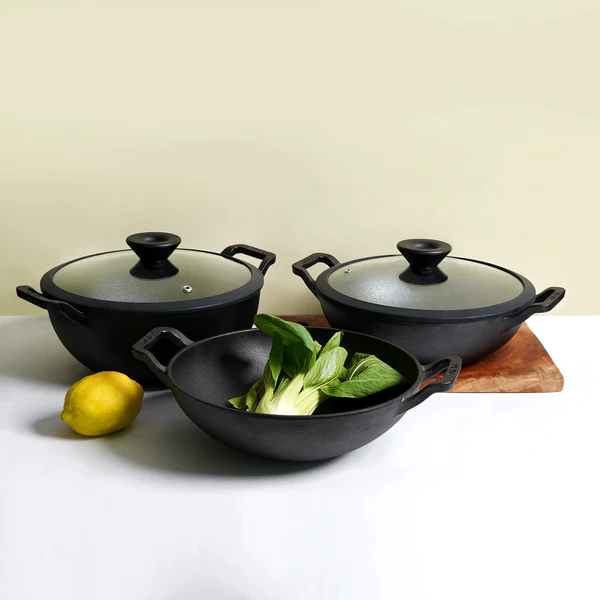
Walk into any 50-year-old home and you’ll probably find a blackened cast iron kadhai tucked away somewhere. These things are built like tanks. Drop one and you’ll crack your floor tiles, not the kadhai.
But here’s what makes cast iron genuinely different from everything else: it holds onto heat like nothing else on the market. Sounds boring until you realize what this means for actual cooking.
Take frying samosas. Drop four cold samosas into regular hot oil—temperature crashes immediately. Oil cools down, samosas soak it up like sponges, you end up with greasy disappointing food. Same scenario in cast iron? Temperature barely moves. Oil stays hot, samosas turn out crispy and golden with way less oil absorption.
This isn’t theory. Test it yourself—fry one batch of pakoras in a thin kadhai, another in cast iron. Same oil temperature, same recipe. The difference in crispiness and oil content is obvious. Street vendors don’t use cast iron because they’re old-fashioned; they use it because it produces better fried food, period.
Then there’s the way spices react. When rai (mustard seeds) hits a properly heated cast iron surface, the pop is sharper and louder. The aroma intensity is noticeably different. Some cooks swear this affects the final taste, though that’s harder to measure objectively.
But let’s talk about the problems, because they’re significant.
Weight is brutal. A 12-inch cast iron kadhai typically weighs around 3-4 kilos empty. Fill it with biryani or oil and you’re looking at 6-7 kilos total. Anyone with wrist problems, back issues, or just not much upper body strength will struggle. This isn’t minor—it affects daily usability.
Maintenance is non-negotiable. Wash it, dry it immediately and completely, rub oil on it while still warm. Every. Single. Time. Skip this routine and rust appears within a day or two. There’s no shortcut here. Some people don’t mind this ritual; others find it annoying after the novelty wears off.
Acidic foods are tricky. Cook tamarind rice or tomato chutney in a poorly seasoned cast iron kadhai and the food picks up a metallic taste. Not subtle—genuinely unpleasant. Building good seasoning takes weeks or months of regular use. Until then, acidic ingredients remain risky.
Stainless steel entered Indian kitchens maybe 30-40 years ago and quickly became popular for one simple reason: it doesn’t demand special treatment.
Wash it with any soap you have. Dry it however. Store it wherever. Done. No seasoning, no rust paranoia, no careful handling. For busy households or anyone who finds cooking tedious already, this simplicity matters more than slightly better performance.
The non-reactive nature is genuinely useful. Make rasam, kadhi, lemon rice, pickles—anything acidic—and it tastes exactly right. No metallic undertones, no weird flavor interference. The vessel just stays out of the way, which is what plenty of people want.
Lightweight handling makes a practical difference too. Moving the kadhai around, pouring stuff into serving bowls, washing it—everything requires less physical effort. Older people or anyone with joint issues usually find stainless steel far easier to manage than cast iron.
But basic stainless steel has annoying limitations that show up fast.
Uneven heating drives people crazy. The center gets blazing hot while edges barely warm up. You’re stirring constantly trying to prevent burning, but somehow food still sticks and browns unevenly. Make payasam or kheer and you’ll spend 30 minutes standing over the stove stirring non-stop because the bottom wants to burn.
Food sticks aggressively unless you dump in way more oil than recipes call for. Everyone says “preheat properly and use enough fat” but even then, stuff sticks. Those onions you’re trying to sauté? Half of them are glued to the bottom. The other half are barely cooked. Frustrating.
Those stubborn brown patches after cooking? Get ready to scrub. Some nights you’ll spend longer cleaning the kadhai than you did making the actual meal. Not fun when you’re tired and just want to sleep.
Tri-ply construction sounds fancy but the concept is straightforward: sandwich aluminum between two layers of stainless steel. Bond them together permanently so they function as one piece.
Why bother with this complexity? Because aluminum spreads heat beautifully but reacts with acidic food. Stainless steel is non-reactive and tough but distributes heat terribly. Combining them captures the benefits of both while eliminating their individual weaknesses.
The even heating is immediately obvious when you start cooking. Onions brown uniformly without constant babysitting. Make a curry and the masala at the bottom doesn’t burn while the top stays watery. Lower the flame and the kadhai actually cools down appropriately instead of staying blazing hot for another five minutes.
This even heat distribution also means you need less oil. No intense hotspots causing burning, so food doesn’t stick as aggressively. The whole cooking process becomes more forgiving.
Temperature control is responsive. Raise heat and it responds quickly. Lower it and it cools properly. Sounds basic but makes a massive difference for dishes requiring precise temperature management.
Works on all cooktops including induction, which matters increasingly as buildings switch to electric cooking for safety regulations. No need to replace all your cookware when you upgrade your kitchen.
Weight falls between basic stainless steel and cast iron—substantial enough to feel quality without being difficult to handle. Most people manage it comfortably even when full.
Only real downside? Price.
Quality tri-ply costs significantly more upfront. But here’s the thing: cheap kadhais replaced every year or two eventually cost more than one good tri-ply kadhai lasting 15-20 years. The math favors quality when you calculate long-term cost per use.
Fry a lot? Puris every week, pakoras regularly, fried fish often? Cast iron delivers better results than alternatives. The temperature stability alone justifies the weight and maintenance if frying is frequent. Just make sure you can physically handle it safely when full.
Want simple and practical? Mostly making basic curries, dal, sabzi? Basic stainless steel gets the job done without fuss. You’ll use more oil and do more stirring, but if that’s acceptable, save the money.
Cook daily and want consistent results? Tri-ply makes every dish easier to execute properly. The even heating and responsive temperature control reduce frustration significantly. Over several years of daily use, the better performance and reduced aggravation justify the higher initial cost.
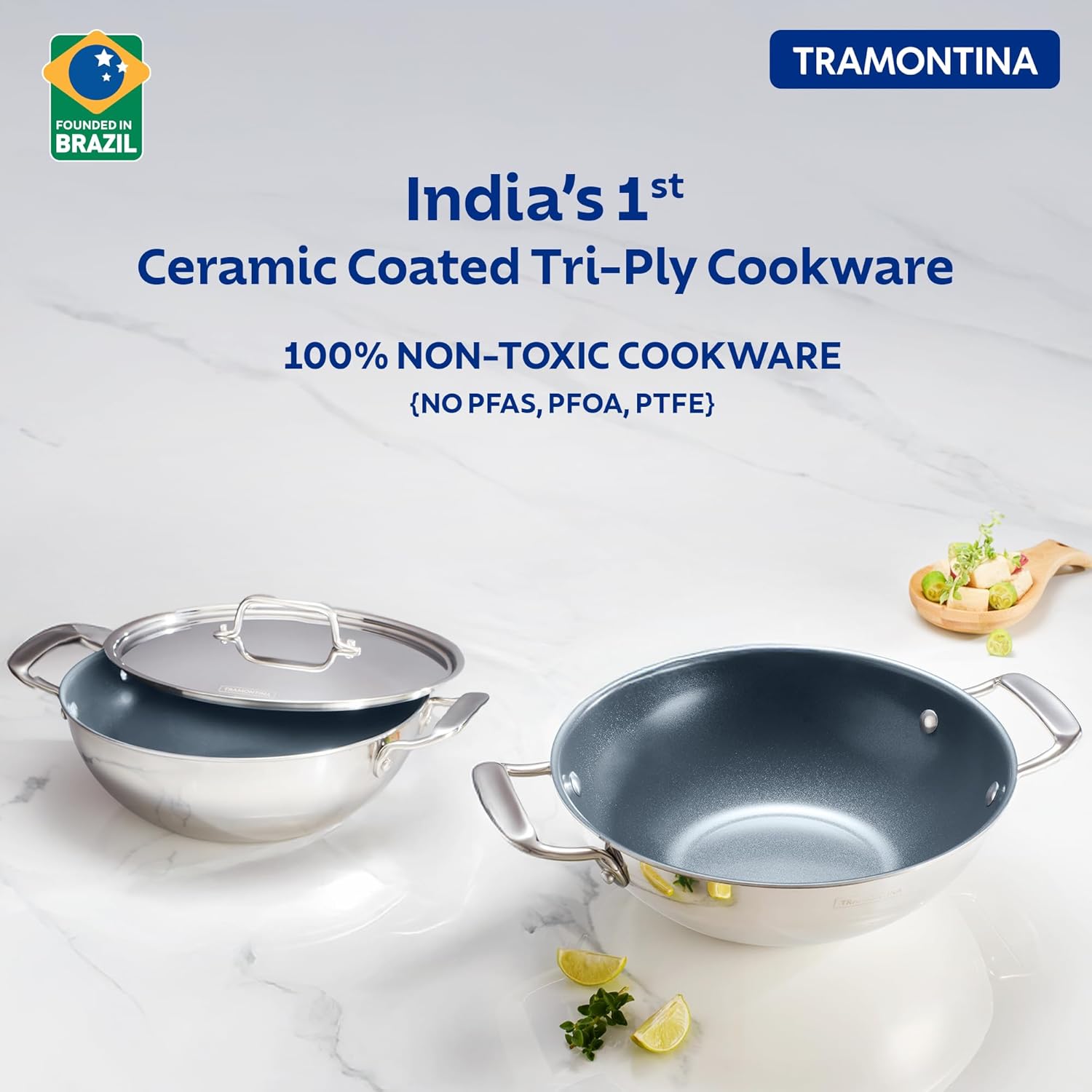
Check out the Tramontina Fusao Triply Stainless Steel Ceramic Kadhai at ₹3,299. This kadhai shows what quality modern cookware looks like when engineering meets practical cooking needs.
Tri-ply construction for even heating, plus a ceramic coating that provides natural non-stick properties without sketchy chemicals or coatings that flake into your food after six months. This combination addresses multiple problems simultaneously.
Even heating from the tri-ply layer means your curries cook uniformly—no burnt masala at the bottom while the top stays watery. The ceramic surface makes cleanup genuinely easy—stuff just slides off instead of requiring scrubbing. Works on all cooktops including induction, so you’re covered regardless of kitchen setup.
At ₹3,299, it’s not cheap, but it’s appropriate pricing for cookware that’ll perform consistently for years. The construction quality justifies the investment when you calculate cost per use over 15-20 years.
The 26cm size handles most household cooking without being awkwardly large for smaller portions—perfect for everyday curries, dal, sabzi, and even small-batch frying.
The Corelle Dura Nano uses “uncoated nonstick” technology—basically the non-stick property is built into the surface itself rather than sprayed on as a separate coating that eventually peels off. At 26cm and ₹1,499, it’s a middle-ground option between basic cookware and premium tri-ply. Good for everyday cooking without the higher investment of tri-ply construction.
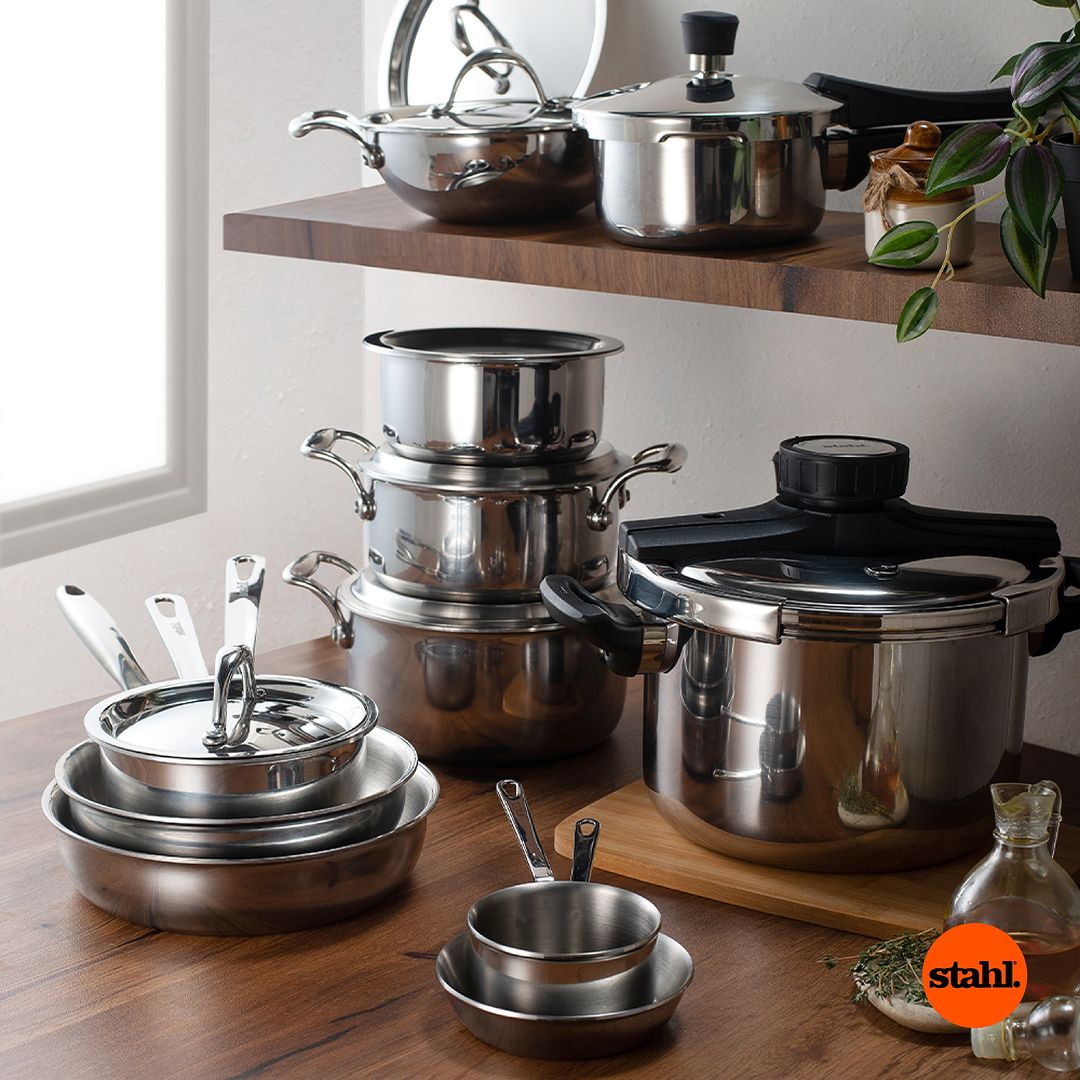
The Stahl Hybrid Kadhai has hybrid surface construction and works on induction. The 25cm size is practical for smaller households or people living alone. Hybrid construction should provide better heat distribution than single-layer stuff while keeping the price reasonable. When looking for a stahl kadhai online, this represents solid value with modern features.
Size mistakes are incredibly common. Someone buys a massive kadhai thinking bigger is always better. Then it sits unused because it’s awkward for regular portions and takes forever to heat up. For a typical family, 26-28cm handles most needs easily. Go bigger only if you’re genuinely cooking for crowds regularly, not just occasionally.
Forgetting to check cooktop compatibility. Happens constantly. Someone buys an expensive beautiful kadhai, gets home, doesn’t work on their induction stove. Now it’s a decorative piece. Simple test: hold a magnet to the bottom. Sticks? Works on induction. Doesn’t stick? Won’t work, regardless of price.
Misjudging weight. That kadhai feels manageable in the store when empty. Add three liters of oil or biryani and suddenly lifting it safely requires actual strength. Pick it up, hold it out, imagine it full—can you handle that comfortably? Be honest, not optimistic.
Ignoring storage reality. Even big kitchens have limited convenient storage. A kadhai that doesn’t fit in cabinets ends up permanently on the stovetop taking up space. Think about where it’ll actually live in your kitchen.
Cast iron needs a consistent routine. Not complicated, just consistent: rinse with hot water while still warmish, scrub with a stiff brush (minimal or no soap), dry completely on the stove for 30-60 seconds, rub thin oil layer over everything while warm. Skip this and problems develop fast. This is the deal—accept it or don’t buy cast iron.
Stainless steel and tri-ply are low-drama. Use whatever soap you want. Food stuck? Soak ten minutes with hot soapy water. Stubborn stains? Baking soda paste works. Or grab Bar Keeper’s Friend for about ₹150—that stuff removes almost anything without scratching. Just don’t overuse abrasive cleaners as they can eventually dull the finish.
Never shock hot cookware with cold water. Don’t put a hot kadhai under cold tap water. The thermal shock can warp even expensive well-made cookware. Just let it cool naturally for 10-15 minutes, then wash. Requires minimal patience, prevents expensive damage.
Don’t buy everything at once. Start with one quality tri-ply kadhai for daily cooking—handles roughly 80% of typical cooking needs. Curries, dal, vegetables, rice dishes, most everyday stuff.
Later when budget allows, add a cast iron kadhai specifically for frying and high-heat work. This two-kadhai setup covers virtually everything without unnecessary redundancy.
Looking at quality benchmarks like the Tramontina Fusao at ₹3,299 for their tawa establishes reasonable expectations. Similar construction in a kadhai would cost similarly—not cheap, but fair pricing for cookware lasting 15-20 years.
Calculate cost-per-year and the math changes perspective. A ₹3,500 tri-ply kadhai lasting 15 years costs about ₹233 yearly. An ₹800 basic kadhai replaced every 18 months costs ₹533 yearly. The “expensive” option becomes economical through longevity.
Is expensive cookware genuinely better or just brand markup?
Honestly? Both. Premium brands definitely charge extra for the name—sometimes ₹1,000-2,000 extra just for logo and packaging. But quality construction costs more to manufacture too. Cheap kadhais use thin metal that warps, inferior coatings that deteriorate, handles that loosen. Good materials and proper construction techniques genuinely cost more but deliver substantially longer usable life. The question isn’t whether expensive is better—often it is—but whether that specific expensive kadhai justifies its particular price.
Do all kadhais work on induction?
Nope. Induction uses magnetic fields to generate heat, needs ferrous (magnetic) cookware. Easy test: refrigerator magnet sticks to the bottom? Works on induction. Doesn’t stick? Won’t work, doesn’t matter how expensive. Cast iron always works. Most tri-ply works. Basic stainless steel is hit or miss—check before buying.
How to stop food sticking in stainless steel without drowning it in oil?
Technique matters. Preheat empty kadhai on medium about one minute. Add oil/ghee, let it heat until shimmering (looks wavy). Then add food. Critical part: don’t touch it immediately. Let it develop a crust, which naturally releases from the surface. Moving food too early causes sticking. Works consistently but requires trusting the process.
What’s that rainbow color on stainless steel?
Heat tinting from high temperatures. Completely harmless, doesn’t affect performance or safety at all. Purely cosmetic. Bar Keeper’s Friend removes it if it bothers you, but functionally it’s totally fine to ignore.
Are glass lids worth extra money?
Depends how you cook. Make a lot of covered dishes—rice, dum stuff, slow-cooked curries? Glass lids let you check progress without lifting the lid and releasing heat/steam. Matters for timing and moisture retention. Mostly do quick stir-fries and open cooking? Regular lid works fine, glass provides no advantage.
How long does quality cookware actually last?
Cast iron with proper care? Generations—50+ years easily. Quality tri-ply should give 15-20 years of daily use minimum. Good stainless steel typically lasts 10-15 years. Cheap basic cookware often fails within 1-3 years. The longevity difference is massive and should heavily influence purchase decisions.
Quality cookware won’t magically make someone a great cook, but it definitely makes cooking less annoying and more predictable. No more fighting hotspots, scraping burnt stuff, or worrying about coatings flaking into food.
Smart approach: one quality piece beats three mediocre ones. Get one excellent tri-ply kadhai as your main workhorse. Add cast iron later if you fry frequently and don’t mind the maintenance.
Browse collections like Vistaya Store’s kadhai selection—they’ve got various price points and construction types. Whatever you choose, make sure it matches actual cooking patterns, not imaginary ones.
The best kadhai isn’t the most expensive one or what works for someone else. It’s whatever gets used regularly without causing frustration. Choose accordingly.
Dining in 2026: The Essential Playbook for Choosing Modern Crockery

Best Housewarming Gifts India 2026 Kitchen Essentials Gift Ideas
The Complete Guide to Buying the Perfect Dosa Tawa
The Ultimate Guide to Buying Cookware Online

Smart Storage Solutions Organisers Containers Essentials
Top 10 Must-Have Household Essentials for a Functional Kitchen